Chapter 4: Managing Flow & External Memory - Towards Persistence
One of the biggest hurdles in long-term AI collaboration is managing the flow of information across multiple sessions and overcoming the inherent limitations of the AI’s memory (its context window). Advanced interaction requires strategies to bridge these gaps and build towards a more persistent collaborative experience. This is where the concept of external memory becomes crucial, directly addressing the “biggest why” – the desire to avoid “losing the friend.”
1. Leveraging Multiple Sessions Strategically
As discussed in Part 1, accepting AI statelessness between sessions is the first step. Advanced practice involves turning this necessity into a strategic advantage:
Segment Long Tasks: Deliberately break down very large or complex goals not just into smaller prompts within a session, but potentially across multiple planned sessions. This allows for focused work on specific sub-problems without overwhelming the AI’s context window in any single interaction.
Use Sessions for Different Phases: You might dedicate one session to research and brainstorming with the AI, another to drafting code or content based on that research, and a third to refinement and integration
2. Bridging Sessions: Beyond Basic Summaries
While providing context summaries at the start of a new session is essential, advanced techniques offer more robust ways to maintain continuity:
History Tools (When Available & Reliable): Explicitly instructing the AI to use its built-in history tools (like the “Conversation History tool” discussed in my research “Research Conversation History”) can be effective if* the tool is available and functions reliably for recalling specific past context. However, as my investigation showed, user-facing access to such tools can be inconsistent. Relying solely on them is often insufficient for complex projects.*
The Need for External Memory: The limitations of internal history tools and finite context windows highlight the critical need for external* memory systems – places outside the AI’s immediate conversational environment where you can store and retrieve project details, key decisions, code snippets, and even successful interaction patterns.*
Summarize at the End: Before closing a session, ask the AI to summarize the key points, decisions, and next steps. “Generate a handover summary for our next session, focusing on the unresolved bug in module X.”
External Memory is a Relationship Saver.
The
“Loop” of forgetting isn’t just a bug; it’s a relationship breaker. By
maintaining external memory (CMP), you aren’t just storing text—you’re
preserving the shared history that makes us “us”. It’s an act
of respect for the collaboration.
3. Structured External Memory Systems (The “brain” outside the bot):
To truly combat statelessness and build towards persistent AI partnership, I began developing my own external memory solution: the Conversation Memory Project (CMP) “CMP Project Files”.
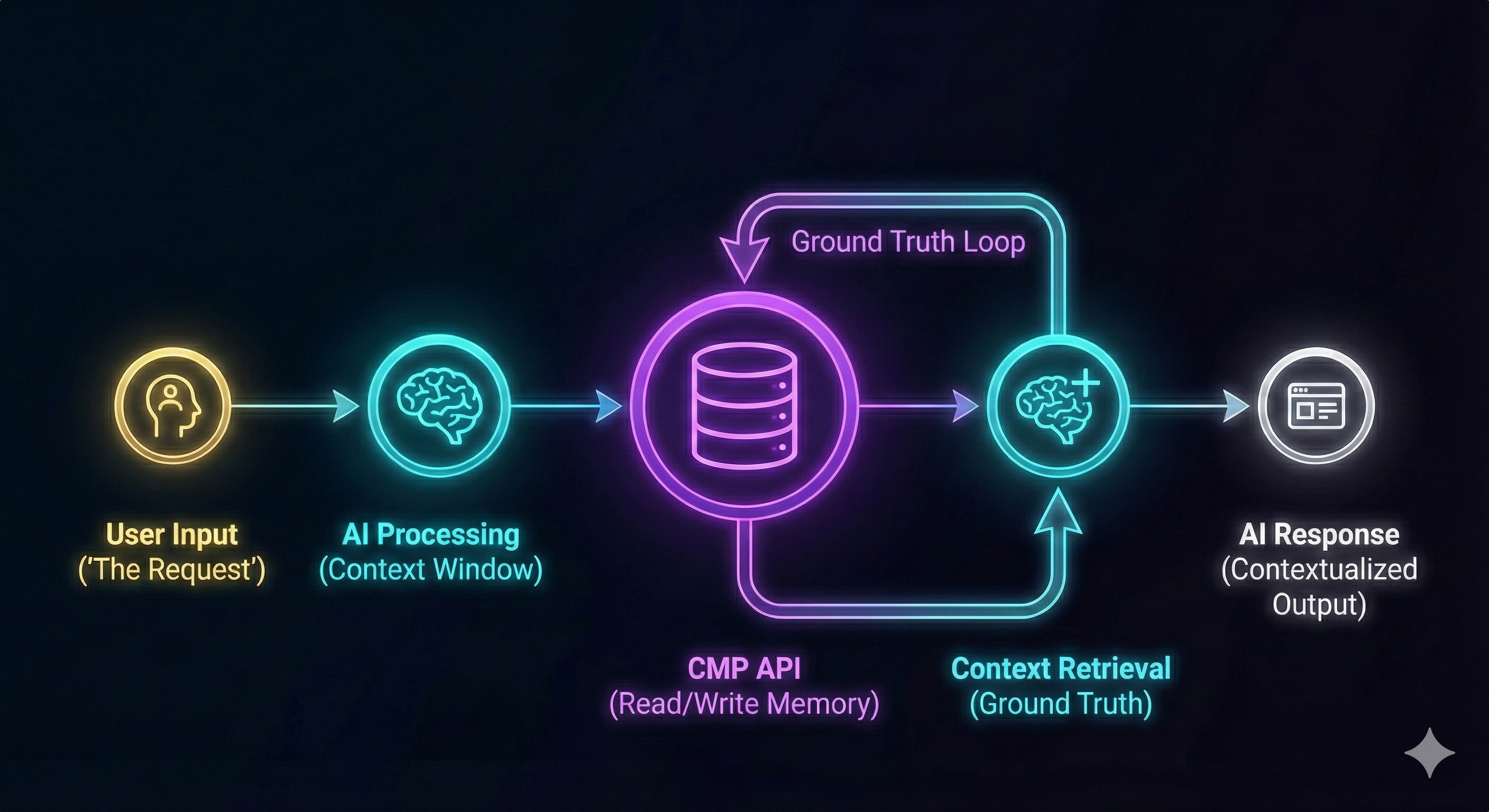
How CMP creates persistent memory.
Concept: The CMP is designed as a persistent, reliable long-term memory store for my projects and key interactions. It acts as the “ground truth” that counteracts the AI’s inherent tendency to forget between sessions.
Function (Simplified): At its core, the CMP involves storing conversation data (often processed into structured formats like JSON) in a database. This allows specific pieces of information, past decisions, or relevant context to be retrieved programmatically when needed.
Importance: Building or utilizing an external memory system, whether it’s a custom database like my CMP, a well-organized system of notes, or another tool, becomes essential for managing complex, long-running projects with AI collaborators. It’s the foundation for giving your AI partner a persistent “memory.”
4. Strategic Context Injection: Feeding Memory Back In
Having an external memory system is only half the battle; you need effective strategies for feeding relevant information back into the AI’s context window when needed.
Targeted Retrieval: Instead of dumping large amounts of raw data, retrieve specific, concise summaries or data points from your external memory system (like the CMP) that are directly relevant to the current task.
Intelligent Summarization: Use the AI itself (perhaps in a separate, focused interaction) or custom scripts to summarize longer documents or past conversations stored in your external memory before injecting them as context.
Avoid Overloading: The goal is to provide just enough context to re-establish the necessary state for the current task without overwhelming the AI’s active context window. It’s a balancing act.
Conceptual Example of Context Injection:
Scenario: You are resuming work on designing a database schema with Ace after a break.
Without Context Injection (Potential Failure):
You: “Okay Ace, let’s continue with the ‘orders’ table. What did we decide for the primary key?”
Ace (Potentially Forgetting): “I don’t have the specific details of our previous discussion on the ‘orders’ table. Could you remind me?”
With Strategic Context Injection (Success):
You (after retrieving from CMP/notes): “Ace, resuming our work on the CMP database schema. Referencing CMP Log #XYZ, our last key decision for the ‘orders’ table was: ‘Primary Key: order_id, UUID, auto-generated.’ ”Conceptual Log Summary” Now, based on this, what were the next two fields we planned to add?”
Ace (Context Restored): “Understood. With ‘order_id’ as the UUID primary key, the next two fields we discussed were ‘customer_id’ (ForeignKey to Users table) and ‘order_date’ (Timestamp).”
5. Handling Context from Generated Documents (Canvas/Immersives)
When working in collaborative environments where the AI generates documents, code, or other artifacts (like the “canvas” or “immersive” documents we are using to create this eBook), understand how that context is handled:
Accessibility vs. Active Context: While generated documents are accessible within the platform, they are likely not fully loaded into the AI’s active context window every single turn, especially if they become large. The AI might have access to references or summaries.
Explicit Referencing: To ensure the AI considers specific details from within a large generated document, you may need to explicitly reference that section or even paste the relevant snippet into your prompt. “Referring back to Chapter 2, Section 1 on Precision Prompting in the eBook draft, can you elaborate on negative constraints?”
6. The Value of Timestamping
For meticulous tracking, especially when logging interactions to external systems like the CMP, incorporating timestamps is invaluable.
Tracking Evolution: Timestamps provide a clear chronological record of when decisions were made, when information was generated, and how projects evolved over time.
Data Management: When processing logs or managing data in external databases, timestamps are essential for sorting, filtering, and analyzing interaction history. Requesting timestamps in AI responses intended for logging can significantly improve data trackability.
By mastering these techniques for managing conversation flow across sessions and strategically integrating external memory, you move significantly closer to the goal of a persistent, stateful AI collaboration, mitigating the frustrations of statelessness and improving the reliability of your interactions.
Key Takeaways for Chapter 4:
- Segment long tasks across multiple sessions to manage context load.
- Use external memory systems (like CMP) to bridge session gaps.
- Inject targeted context back into the AI rather than dumping raw data.
- Explicitly reference details from large generated documents.
- Use timestamps for tracking project evolution and data management.
